Percentage Points vs Percent: 5 Mistakes That Change the Answer
A rate that falls 1% and one that falls 1 percentage point are ten times apart. That confusion, plus four more that quietly turn a correct number wrong.
Percentages are the only piece of arithmetic almost everyone claims to be comfortable with, and the only one where two careful people routinely get different answers from the same sentence. Not because the arithmetic is hard. Because the sentence usually leaves out what the percentage is a percentage of.
Five places that happens, starting with the one that does the most damage.
A rate cannot fall by 1% and by 1 point at the same time
If a number is already a percentage, "it fell by 1%" is ambiguous, and the two readings are not close together.
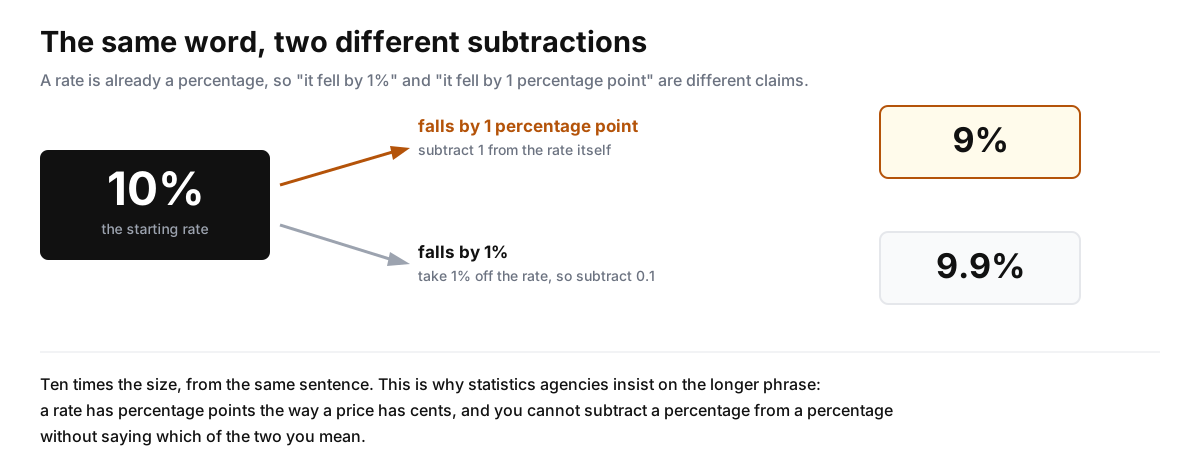
A percentage point is the plain arithmetic gap between two percentages. A percent is a relative change. The Office for National Statistics spells it out for its own writers: a value of 10% falling by 1 percentage point becomes 9%, while a fall of 1% leaves 9.9%1.
Ten times apart, from one word.
This is why "unemployment rose 5%" is not a sentence that means anything on its own. It could be five percentage points, which would be a catastrophe, or five percent of the rate, which on a 4% baseline is a move to 4.2% and barely noise. Both are legitimate readings of the words.
The check that catches it every time: ask percent of what. Five percent of a 4% rate is 0.2 points. Five percent of a 50% rate is 2.5 points. The identical phrase describes something 12.5 times larger on the second baseline.
Losses and gains of the same size do not cancel
Take a number down 50%, then back up 50%. You are not where you started. 100 becomes 50, and 50 becomes 75.
The gain you need to undo a loss is always larger than the loss, and the gap widens fast.
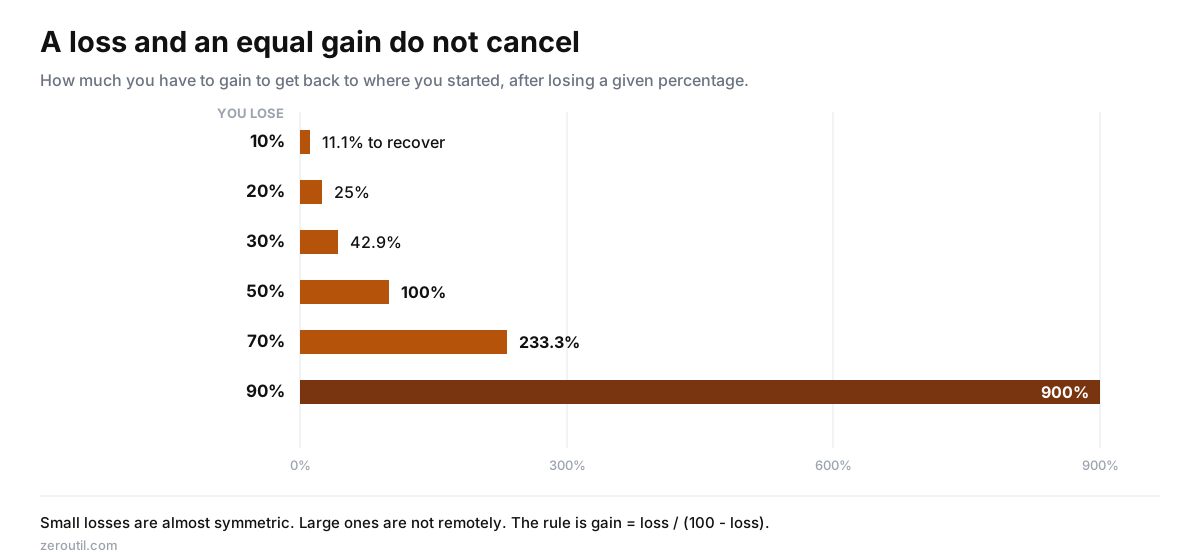
The rule is gain = loss / (100 - loss). Lose 10% and you need 11.1% back, which nobody would notice. Lose 90% and you need 900%.
Two everyday versions of the same shape: a business that loses 30% of its customers has to grow the remainder by 42.9% just to get back to where it was, and a portion size cut 20% and then increased 20% ends up 4% smaller than it started.
Markup and margin describe the same money
Buy something for 60, sell it for 100. The profit is 40 either way, but:
- Markup measures it against cost:
40 / 60 = 66.7% - Margin measures it against revenue:
40 / 100 = 40%
Neither is wrong. They have different denominators, so they produce very different-looking numbers for an identical deal, and a supplier quoting markup while a buyer hears margin is a genuinely expensive misunderstanding.
Convert with markup / (1 + markup) for margin, and margin / (1 - margin) for markup. A 50% markup is a 33% margin. A 40% margin is a 66.7% markup.
Sequential percentages multiply
Twenty percent off, then another ten percent off the reduced price, is not thirty percent off. The second cut comes off a smaller number.
1 - (0.8 × 0.9) = 0.28Twenty-eight percent. Always less than the sum, always by more than people expect as the discounts get bigger. Our Discount Calculator composes stacked discounts correctly, and the discount math piece works through the retail cases in more detail.
The same multiplication catches out returns. An investment that gained 10% in a year when inflation ran 3% did not net 7%. It netted (1.10 / 1.03) - 1, which is 6.8%. And a 1% gain every month for a year is 12.68%, not 12%, which is compounding doing what compounding does.
A percentage without its base rate is not evidence
This is the one that survives contact with intelligent people, because the arithmetic is invisible until you write it out.
A screening test is 95% accurate in both directions: it catches 95% of real cases and correctly clears 95% of healthy people. Someone you know tests positive. How likely is it that they have the disease?
The instinct says 95%. The answer depends on something the question never mentioned: how common the disease is.
Say it affects 1% of the population being tested. In 10,000 people:
- 100 have it. The test flags 95 of them.
- 9,900 do not. The test wrongly flags 5% of those, which is 495.
- Positive results total 590, of which 95 are real.
That is 16.1%. A 95%-accurate test, pointed at a 1% disease, produces positives that are wrong five times out of six. Nothing is broken; the predictive value of a positive result depends on prevalence in the population tested, not on the accuracy figure alone2.
The pattern generalises past medicine. A breach detector with a 0.1% false-positive rate on a million requests a day hands you a thousand false alarms daily. A forecaster claiming 85% accuracy is unimpressive if predicting "no earthquake today" every single day would score 99.9%. In both cases the accuracy number is true and the conclusion drawn from it is not.
Quick checks worth memorising
- 50% off and then 50% off is 75% off, not free.
- A 100% gain is a doubling. A 200% increase is a tripling.
- "Up by a factor of 10" is a 900% increase, not 1000%.
- 37.5% is
3/8, 66.7% is2/3, 12.5% is1/8. For splits and proportions a fraction is often the clearer unit, which is what our Fraction Calculator is for.
Our Percentage Calculator handles the direct arithmetic, but none of the five mistakes above are arithmetic failures. They are all the same failure: a percentage quoted without the thing it is a percentage of. When you meet one in the wild, that is the question to ask first, and usually the only one you need.
Sources
Every number in this article traces to a source below. Where a claim could not be sourced, it was cut rather than softened.
- Primary sourceUK Office for National Statistics
The definition of a percentage point, and the worked example that a value of 10% falling by 1 percentage point becomes 9% while a fall of 1% becomes 9.9%.
- Peer-reviewedStatPearls, NCBI Bookshelf
That the predictive value of a positive test depends on prevalence in the tested population, not on the test's accuracy alone.
Topics
- Percentages
- Math
- Finance
- Basics
- Statistics
Tools mentioned in this article
- Percentage Calculator - Calculate percentages: X% of Y, percentage increase/decrease, and more.
Get new tools by email
New tools and the occasional deep-dive, about once a month. No spam, no sharing your address, unsubscribe in one click.